Edge

Khasm Labs
10
min read
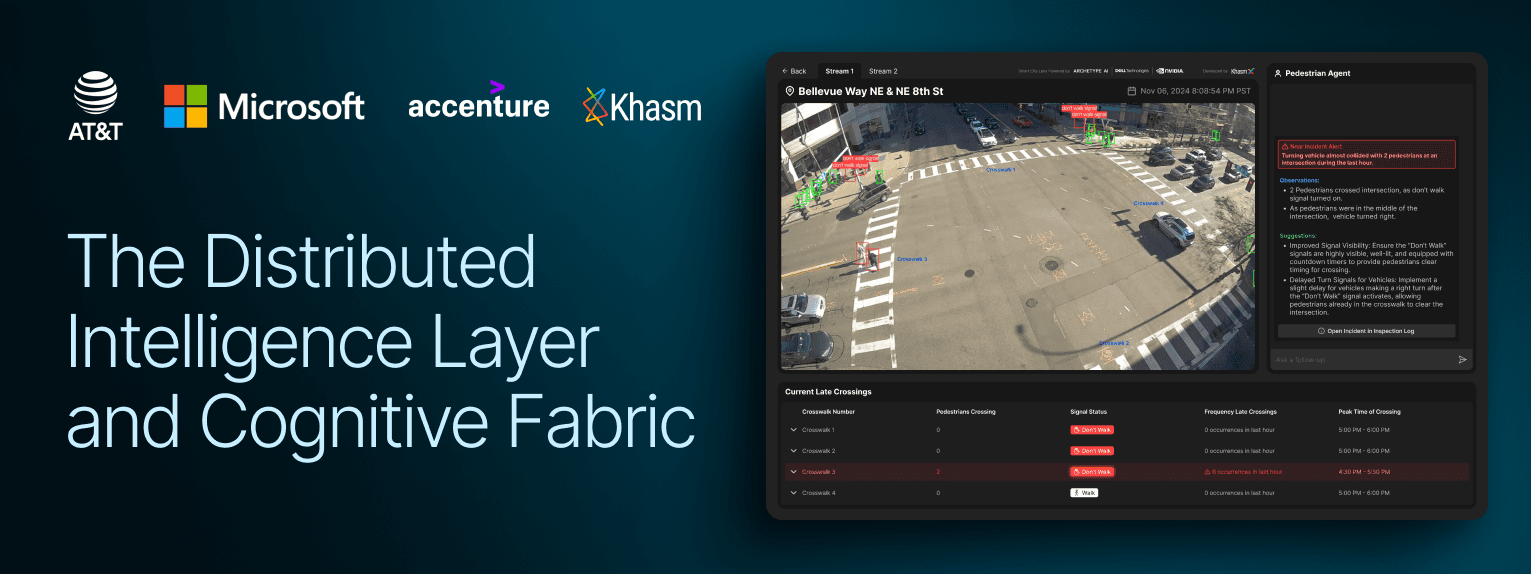
Enterprises are moving rapidly toward an era of autonomous operations, where software systems do more than monitor and recommend—they perceive, reason, and act in real time. This shift is driven by agentic AI and machine learning models that require a constant stream of contextual data, secure orchestration, and deterministic execution.
Yet most enterprise AI architectures remain centralized. They rely on transporting raw sensor and video data to a cloud region for processing—an approach increasingly constrained by latency, data sovereignty requirements, and the economics of data gravity and egress.
To address these constraints, AT&T, Microsoft, Khasm Labs, and Accenture are working together on the Telco AI Cloud (TAC) pilot, a distributed architecture designed to bring secure, scalable AI inference and orchestration closer to where data is generated: the edge.
As the pilot’s reference use case, Khasm Labs partnered with the City of Bellevue, in Washington state, to develop and deploy an AI application called Traffic Management Lens (TML)—built on Archetype AI’s Newton model—to enable real-time safety actions at intersections focused on pedestrian safety.
This whitepaper explains:
The TAC pilot architecture and why it matters now
The Bellevue reference architecture (“Bellevue Blueprint”)
The security model and resilience strategy for distributed AI
How CIOs, ISVs, and telcos can apply this approach to broader edge AI deployments
Why Centralized AI Is Colliding with Reality
Enterprises don’t suffer from a lack of data, they suffer from the inability to act on it fast enough, securely enough, and economically enough. For the last decade, the dominant enterprise AI pattern has been to collect data at the edge and move it upstream to centralized cloud environments for processing. That model worked when AI was primarily used for analytics, reporting, and optimization. But it begins to break down when AI is expected to drive real-time decisions that affect physical operations, customer experience, and safety-critical workflows.
As AI moves from “analysis” into “execution,” the operating requirements change fundamentally. Latency is no longer a technical inconvenience; it becomes operational risk in mission-critical environments where delays translate into real-world consequences. Data sovereignty also shifts from being a legal or compliance conversation into an architectural requirement, because the path data takes, and where it is processed, can be as important as what the data contains.
At the same time, transporting raw sensor and video streams to centralized clouds is becoming economically unsustainable, driven by bandwidth consumption, cloud ingestion costs, and the compounding burden of data movement at scale. And finally, as organizations attempt to connect AI systems to the physical world, OT/IT integration emerges as the true bottleneck—because the hardest part of deploying AI is not inference, it is reliable execution through real-world control systems.
For many organizations, the next era of competitive advantage will not be defined by who has the best model running in a distant cloud, but by who can deploy intelligence closest to the point of action—where data is created, decisions must be made in real time, and outcomes can be executed with confidence.
The TAC Pilot: Distributed AI for the Enterprise Edge
The Telco AI Cloud (TAC) pilot was created to address a growing reality facing enterprises across every industry: the most valuable data is increasingly generated outside the data center, yet the most consequential decisions still depend on centralized architectures that were never designed for real-time action. As organizations deploy AI deeper into operations, they are discovering that intelligence must move closer to where work happens whether that is a factory floor, a distribution yard, a port, a hospital, a retail environment, or a city intersection.
To meet this need, AT&T, Microsoft, Khasm Labs, and Accenture unveiled the TAC pilot as a distributed architecture designed to bring secure, scalable AI capabilities to the edge. The pilot is built on the premise that real-time inference should occur close to where data originates, while cloud environments should provide the broader reasoning, governance, and policy logic needed to manage decision-making at scale.
What makes TAC distinct is that it is not simply an edge compute experiment. It is an orchestration model that connects perception, reasoning, and execution across a distributed fabric, with security and identity designed to support enterprise-grade deployments. The pilot’s intent is to validate how telco-grade infrastructure can provide the low-latency, high-integrity foundation for AI services that must operate in real time, while still integrating with cloud ecosystems that enterprises already rely on for management and control.
The Bellevue Blueprint: Solving the Physics of Action
The maturity of the TAC pilot is validated by its transition from passive monitoring to active, real-time operational management. In the City of Bellevue, Khasm Labs developed and deployed an AI application called Traffic Management Lens (TML), built on Archetype AI’s Newton model, with the purpose of enabling real-time agentic actions at intersections to improve pedestrian safety.
Bellevue provides a powerful proving ground for distributed intelligence because intersections represent a physical environment where timing constraints are real, consequences are measurable, and execution must be reliable. Unlike traditional analytics use cases, where delayed insights can still be valuable, safety decisions at intersections must happen within strict windows governed by signal phase timing and the physical realities of human movement. Bellevue’s environment therefore becomes a living reference architecture for understanding how AI must behave when milliseconds and seconds matter not only for perception and reasoning, but for the final act of execution.
The Bellevue deployment also reflects a broader enterprise truth: the edge is rarely uniform. Cities vary in infrastructure maturity, sensing density, connectivity quality, and budget constraints. That reality shaped the design principles behind TML, which focused on enabling real-time outcomes using existing infrastructure wherever possible rather than requiring expensive new sensing fabrics as the baseline. In this way, Bellevue becomes more than a pilot site, it becomes a blueprint for how distributed intelligence can be applied in environments where enterprises must modernize without rebuilding everything from scratch.
Architectural Deep Dive: Orchestrating the Cognitive Fabric
The TAC pilot introduces what we refer to as the Cognitive Fabric: a secure orchestration layer designed to coordinate AI workloads from the edge to the cloud while preserving identity, integrity, and data sovereignty in motion. The Cognitive Fabric is not simply a connectivity layer, nor is it merely a deployment framework. It is the operational model that allows AI systems to perceive locally, escalate intelligently, and execute deterministically across distributed environments without forcing every decision into a centralized cloud round-trip.
In Bellevue, TML continuously ingests high-resolution RTSP video streams from intersection cameras into AT&T’s AI Cloud through a private transport path designed for controlled, sovereign data movement. Localized AI agents running in the AT&T environment perform continuous inference on these streams, monitoring for behavioral anomalies such as pedestrians entering late in a signal cycle or moving too slowly to safely complete a crossing before the phase ends. This approach enables raw video to remain close to the source while only relevant metadata and event triggers are transmitted upstream, reducing the cost and inefficiency of transporting constant high-definition video into centralized cloud environments.
A defining capability of this architecture is its fusion of physical perception with digital context. Video provides the system with vision, but vision alone does not provide intent. To understand the true state of an intersection, the system also ingests SPaT data, signal phase and timing messages that represent the digital language traffic controllers use to broadcast the state of lights and phases. This allows the AI agent to interpret not only what it sees, but what the intersection is attempting to do at that moment, including exactly how many seconds remain in a walk or green phase. By aligning pedestrian progress with remaining phase time, the system can determine whether risk is emerging and whether a signal extension is warranted.
When a localized agent detects a critical anomaly, it triggers escalation to an Azure-resident decision layer. Within Microsoft Azure, larger models and policy logic can evaluate the event using broader context, such as historical traffic patterns or city-level coordination considerations and return a definitive safety decision. Once a decision is made, the command is relayed back to the edge for execution. In Bellevue, execution occurs through direct integration with remote I/O devices using the EIA/TIA RS-485 protocol, enabling deterministic signaling into the traffic controller cabinet to extend the pedestrian phase in real time. This final step, reliable execution through OT integration, is what transforms an AI system from an observer into an operational actor.
The Digital-Physical Interface: Local Signal Integration
For CIOs and IT leaders, one of the most important lessons from edge AI deployments is that the hardest part of operationalizing intelligence is not building a model—it is bridging the gap between digital logic and physical systems. This is especially true in environments where operational technology governs critical processes and where systems were never designed to accept real-time AI-driven commands.
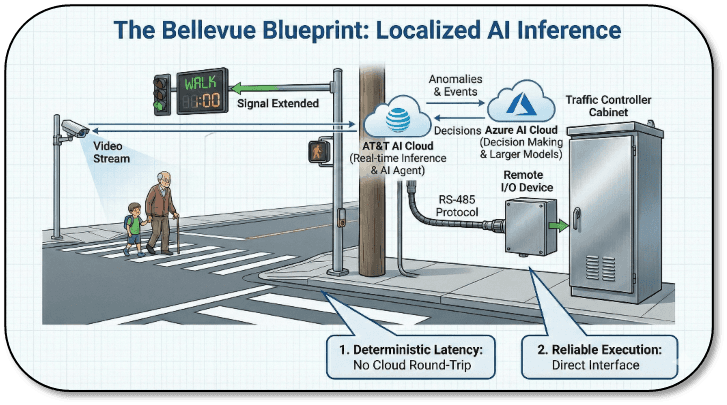
In the Bellevue deployment, the traffic controller cabinet represents the real-world interface between intelligence and action. The architecture relies on integrating AI agents with remote I/O devices at each intersection, allowing software decisions to translate into physical signal changes. This OT/IT bridge is a pattern enterprises will increasingly encounter across industries, from manufacturing lines and energy grids to ports, logistics yards, and healthcare environments. The physical world runs on deterministic interfaces, not cloud APIs, and the ability to reliably execute actions is what separates experimental AI from production-grade autonomy.
At the same time, edge environments are highly variable. Some municipalities have fiber connectivity, extensive sensing networks, and advanced signal automation, while others operate with limited infrastructure and constrained budgets. These realities shaped the design of TML, which was intentionally built to reduce dependency on expensive sensing equipment and specialized edge compute nodes, instead enabling real-time outcomes using widely available camera infrastructure combined with secure transport and distributed orchestration. This design approach reflects a broader enterprise truth: edge AI must scale across uneven environments, and architecture must be resilient to inconsistency rather than dependent on ideal conditions.
Security: The SIM-to-Cloud Mandate
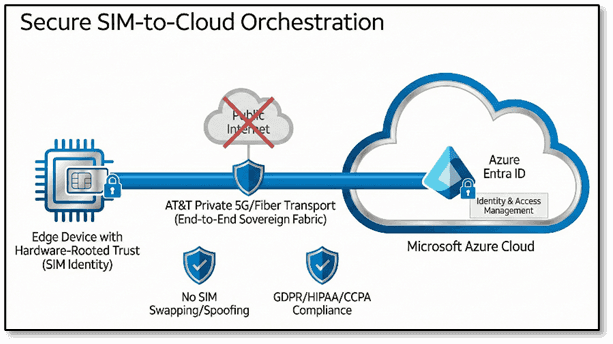
As AI becomes distributed, security must evolve with it. Traditional enterprise security models are often software-heavy and operationally complex, relying on layers of certificates, endpoint agents, constant patching, and rotating credentials across a rapidly expanding set of edge environments. In distributed deployments, this approach can increase architectural debt and introduce new failure modes that are difficult to manage at scale.
The TAC pilot explores a model we refer to as SIM-to-Cloud, where identity and trust are anchored closer to hardware and transport is managed through a controlled network fabric. By rooting identity at the device level and using a sovereign transport path, the architecture reduces reliance on the public internet as the default conduit for mission-critical data and enables a consistent trust posture across distributed endpoints.
This security approach also creates a strategic advantage for enterprises and ISVs by abstracting security away from the application layer. Rather than requiring every independent software vendor to build its own security plumbing, identity, and transport controls, the fabric can provide a standardized foundation that applications inherit. For CIOs, this can translate into unified governance, reduced friction in onboarding new applications, and faster time-to-value for distributed AI services because the security posture is designed into the infrastructure rather than rebuilt for every deployment.
In practical terms, TAC explores linking AT&T’s secure SIM and device identity into the architecture supporting edge devices, allowing edge devices and systems to align with enterprise identity governance while maintaining a secure and controlled transport path between the edge and cloud environments. This approach supports stronger consistency in identity and policy enforcement across distributed deployments, which is essential as enterprises scale toward thousands of edge locations.
Resiliency: Designing for Failure Without Losing Safety
Resilience is not a future enhancement; it is a prerequisite for any architecture intended to operate in real-world environments. Outages, fiber cuts, power disruptions, and regional connectivity failures are inevitable, and distributed AI systems must be designed to treat these disruptions as operating conditions rather than exceptional events.
In the TAC model, resilience is achieved through a dual-tier approach that addresses both connectivity and orchestration continuity. The first layer focuses on connectivity sovereignty, where multi-provider SIM strategies can provide carrier failover in the event of transport disruption. By leveraging dual-SIM or eSIM-capable edge devices, enterprises can embed secondary and tertiary connectivity profiles alongside the primary network, enabling a self-healing transport layer that maintains service availability without compromising identity integrity.
The second layer focuses on orchestration resilience. In distributed AI systems, decision-making cannot depend entirely on a single centralized brain. While Azure provides higher-level reasoning and policy logic, the edge must retain enough intelligence to maintain safe operation if connectivity to cloud reasoning is interrupted. In Bellevue, this means that if the link to the Azure-resident decision layer were severed, the AT&T-resident agent could still execute pre-verified safety extensions based on local inference, ensuring mission-critical safety actions remain deterministic and local. Once connectivity is restored, the system can synchronize buffered events and metadata to preserve audit trails and analytical continuity.
The Ecosystem Advantage: Avoiding the Walled Garden
One of the most important strategic design choices in TAC is its commitment to openness. Enterprises are increasingly wary of vertically integrated architectures that lock them into proprietary stacks, tools, and models. The TAC approach is intentionally decoupled, enabling telco infrastructure to provide the transport, inference proximity, and security plumbing while allowing enterprises to maintain sovereignty over their intelligence layer.
For CIOs, this openness supports a build-once, deploy-everywhere strategy. As models evolve, the infrastructure remains a consistent execution plane, allowing organizations to bring their own models and integrate third-party ISV solutions without redesigning the underlying architecture each time. This reduces lock-in risk and supports long-term flexibility as AI frameworks and workloads continue to change.
Operational Scaling for ISVs
For independent software vendors (ISVs), the TAC model creates a new deployment target: the distributed telco edge as a standardized execution environment. Historically, ISVs have been constrained by fragmented edge deployments that require bespoke hardware footprints, inconsistent connectivity, and custom security integrations for each customer environment. TAC offers a pathway toward treating the edge as a scalable platform rather than a collection of one-off deployments.
By leveraging Azure-native operational continuity through tools such as Azure Arc, ISVs can manage distributed AI frameworks across thousands of locations with the same governance and lifecycle controls they apply in cloud environments. This aligns infrastructure cost with consumption rather than forcing ISVs to own and manage complex hardware deployments, and it allows AI workloads to migrate toward the point of data generation, reducing the economic burden of backhauling raw sensor, video streams or other data types into centralized cloud regions.
Conclusion: The Foundational Layer of Global Industry
Telco AI Cloud is a response to the physics and economics of modern AI. As enterprises push intelligence deeper into operations, centralized architectures are increasingly constrained by latency, cost, and sovereignty requirements that cannot be solved through incremental improvements alone. Distributed intelligence is becoming foundational infrastructure for the next era of enterprise competitiveness.
By bringing inference closer to where data is generated, anchoring trust in stronger identity and transport models, and enabling deterministic OT execution, TAC is proving the potential of providing a blueprint for how enterprises can finally act on data where it resides. The Cognitive Fabric is not a conceptual framework—it is an emerging operating layer for the Autonomous Enterprise, enabling AI systems to perceive locally, reason at scale, and execute reliably in the environments where outcomes matter most.
Editorial Notes & References
Strategic Industry Research
Gartner: The 2025 Edge Computing Hype Cycle Gartner Edge Computing Research. Key Insight: Validates that by 2025, 75% of enterprise data will be processed at the edge, and introduces the shift toward Agentic AI in distributed environments.
Forrester: Predictions 2026 – Automation at the Crossroads Forrester Automation & Robotics 2026. Key Insight: Discusses the transition from deterministic automation to Agentic AI and the necessity of an "Automation Fabric" to orchestrate value across streams.
Forrester Consulting: Building the Autonomous Enterprise Forrester/Automation Anywhere Study. Key Insight: Explores the drivers and challenges for organizations adopting AI agents to achieve autonomous operations.
Technical & Architectural Validation
MIT CSAIL: Distributed Robotics and Parallel Systems MIT Distributed Robotics Laboratory. Key Insight: Foundational research on Distributed Intelligence and algorithms that allow machines to collaborate and reason in the physical world.
Microsoft Azure: The Open Agentic Web Stack Microsoft Azure Agent Factory Blog. Key Insight: Details the integration of Microsoft Entra ID with agentic frameworks and the importance of verifiable identity in the "agentic web."
AT&T & Microsoft: NetBond for Azure Integration AT&T NetBond Technical Overview. Key Insight: Technical documentation on how AT&T NetBond and Azure ExpressRoute create a private, secure fabric that bypasses the public internet.