Innovate

Khasm Labs
10
min read

Private 5G can provide the secure coverage, mobility and performance organizations need across large, complex and mission-critical environments. But deploying the network is only the beginning.
The real value appears when the right devices connect people, vehicles, machines and applications to that network.
A rugged tablet can give a field technician access to live equipment data. A mobile router can keep a vehicle connected as it moves across a site. A USB modem can bring an existing laptop onto a private network without requiring a major hardware replacement. An industrial router can connect a remote asset that was previously difficult to monitor.
Each device solves a different part of the operational problem. Together, they turn connectivity into action.
That is why Khasm Labs created the KEEN Marketplace: to help organizations find enterprise devices evaluated for private 5G and the environments where reliable connectivity matters most.
A Device Specification Does Not Tell the Whole Story
Buying a device based on a specification sheet alone can create problems later. A product may advertise 5G connectivity, but that does not automatically mean it is ready for the private cellular network, spectrum band or operating environment an organization plans to use.
Teams still need to answer practical questions:
Does the device support 5G Standalone connectivity?
Does it support the private cellular bands used by the network, including CBRS Band n48 in the United States?
Can it handle the temperature, dust, vibration or moisture found in the operating environment?
Does its form factor fit the way workers or equipment actually move?
Can it run the organization’s required applications?
How will it be provisioned, secured and managed?
These questions become especially important when a device is expected to support a mission-critical workflow. Compatibility should not be discovered after deployment.
What Is a Khasm-Validated Device?
Devices in the KEEN Marketplace are selected for enterprise use and evaluated by Khasm Labs for connectivity with modern private 5G networks. Marketplace listings identify validation for 5G Standalone and private cellular bands such as n48 CBRS, along with the device class and the use cases it is designed to support.
This gives customers a clearer starting point. Instead of treating the device and network as separate purchases, organizations can plan them as parts of one operational system.
Here is what that can look like across a real deployment.
Connect Existing Computers Without Replacing Them

Many organizations already have laptops, workstations or industrial computers that still serve their teams well. The challenge is giving those devices access to a new private cellular network.
The Horizon DG505G USB Dongle provides plug-and-play 5G connectivity for compatible computers and endpoints. It can be a practical option for:
Connecting an existing laptop to a private 5G network
Equipping contractors or temporary teams with site connectivity
Enabling mobile workstations in vehicles or field locations
Supporting pilots without replacing an entire device fleet
Adding a cellular connection to specialized equipment with a compatible USB interface
This can reduce the barrier to adoption. An organization can introduce private 5G where it creates immediate value while continuing to use existing hardware.
Give Mobile Workers a Rugged, Always-Connected Workspace
Consumer tablets are not designed for every operational environment. Ports, utilities, factories, construction sites and public-safety operations may expose devices to drops, vibration, weather and long shifts away from a desk.

The Zebra ET65 is an ultra-rugged 5G tablet designed for demanding enterprise environments and secure, always-on mobility. Teams could use it to:
Access digital work orders and asset histories
Complete inspections and document conditions in the field
View maps, schematics or operating procedures
Capture photos, signatures and real-time status updates
Connect to dispatch, inventory or maintenance applications
On a KEEN private network, the tablet becomes more than a mobile screen. It becomes a secure point of access to the systems and information that keep the operation moving.
Bring High-Performance Computing into the Field
Some jobs require the capabilities of a full computer in places where an office laptop may not survive. Engineers, technicians, incident-response teams and field operators may need local processing power, secure application access and a durable form factor.
The Dell Rugged 7030 is a fully rugged 5G laptop built for extreme field environments. It can support use cases such as:
Equipment diagnostics and configuration
Field engineering and commissioning
Secure access to operational applications
Video, mapping and data-intensive workflows
Mobile command and incident response
Paired with private 5G, a rugged laptop allows teams to take more capability to the point of work instead of moving the work back to a fixed office connection.

Keep Vehicles and Mobile Operations Connected
Vehicles are becoming connected operating environments. Service fleets, yard trucks, public-safety vehicles and mobile command units may rely on cameras, tablets, sensors and onboard applications—all while moving across changing coverage conditions.
The Cradlepoint R1900 is a ruggedized mobile 5G router designed for vehicle fleets and industrial deployments. It can help connect:
In-vehicle computers and tablets
Cameras and video systems
Telematics and diagnostic equipment
Mobile work crews
Temporary command or response operations
Connected to KEEN, a vehicle can become part of the private operational network rather than an isolated asset. That gives teams a more consistent path for sending data, accessing applications and coordinating work across a large site.

Extend Connectivity to Remote and Outdoor Areas
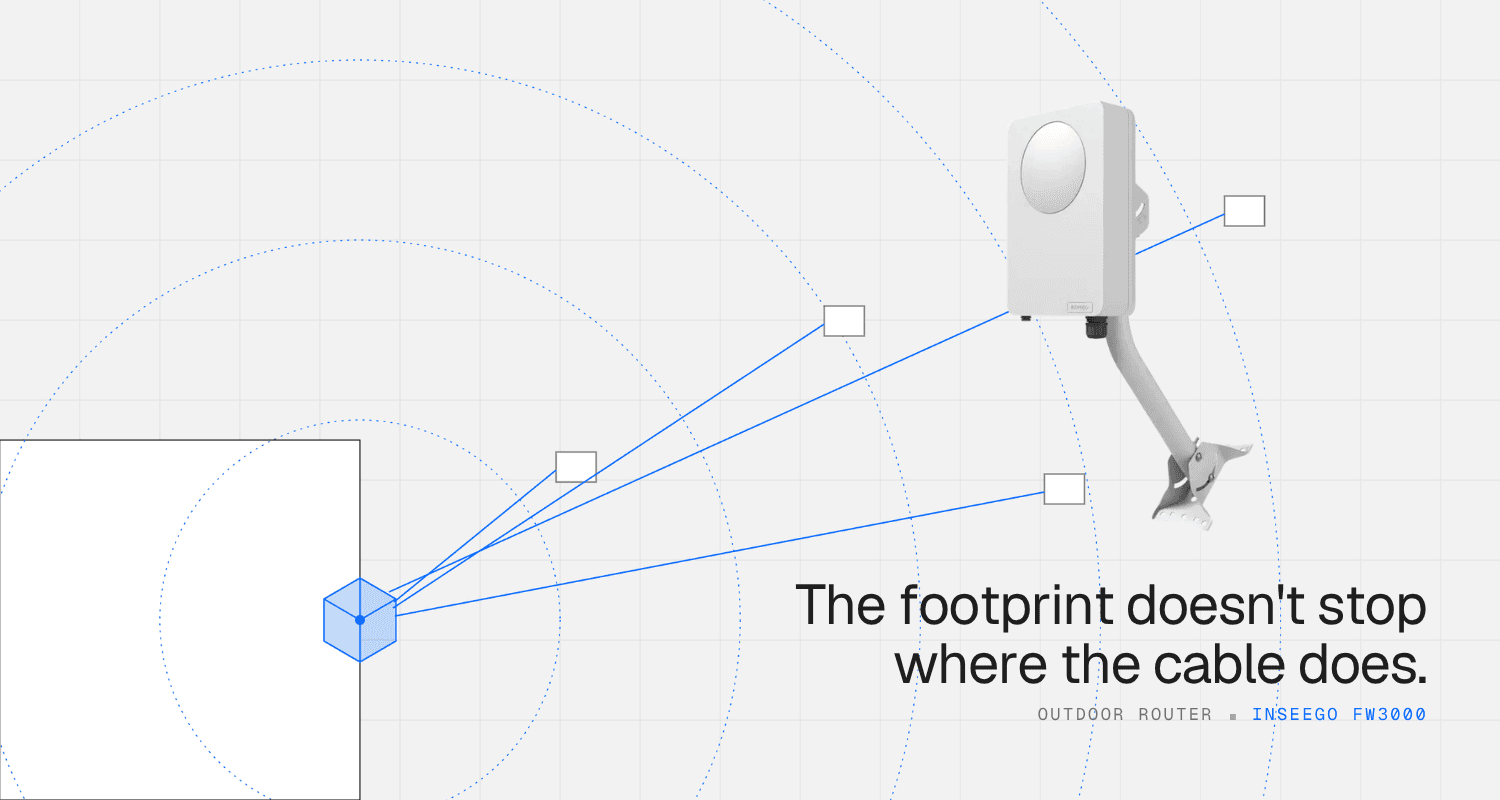
Operational footprints rarely stop at the wall of a building. Organizations may need to connect gates, yards, storage areas, temporary sites, remote facilities or equipment positioned far from traditional network infrastructure.
An outdoor 5G router such as the Inseego FW3000 can provide a hardened connection for industrial and fixed-wireless deployments. It could be used to support:
Remote buildings or work areas
Outdoor cameras and security systems
Temporary operating locations
Backup connectivity for a critical site
Equipment and applications beyond the reach of wired infrastructure
This allows organizations to think about coverage based on the full operational footprint and not just the areas that are easiest to cable.
Why the Network and the Device Must Be Planned Together
The device is where a worker or machine experiences the network. If that endpoint is incompatible, fragile or poorly matched to the workflow, even a strong network deployment will struggle to deliver its intended value.
The reverse is also true. A capable 5G device cannot solve coverage gaps, cloud latency or an unreliable network on its own.
Keen brings private 5G connectivity and edge computing together in an open platform for industrial and mission-critical operations. It is designed to support secure device connectivity, on-site application processing and centralized visibility across the network.
When KEEN and validated devices are planned as one system, organizations can create a stronger foundation for:
Connected workers and field mobility
Industrial IoT and remote asset monitoring
Video analytics and physical security
Vehicle and fleet connectivity
Robotics and autonomous systems
Edge AI and real-time decision-making
The goal is not connectivity for connectivity’s sake. The goal is to remove operational friction: fewer dead zones, faster access to information, better visibility and more reliable communication between people, devices and applications.
Start with One Workflow, Then Build From There
A private 5G initiative does not need to begin with every device and application across an organization. A focused starting point often creates a clearer path forward.
Begin with a workflow where connectivity is already limiting performance. That might be technicians losing access to maintenance systems, vehicles operating without consistent communications, cameras unable to transmit video reliably or remote assets that cannot be monitored in real time.
Then define the complete solution:
Identify the operational outcome.
Select the devices that fit the users and environment.
Design coverage around where those devices must operate.
Determine which data and applications should run at the edge.
Validate the workflow before expanding it across the site.
This approach makes the project easier to measure and gives the organization a repeatable model for adding new users, devices and applications.
Build the Network Around the Mission
The right private 5G network creates the foundation. The right devices turn that foundation into real work.
By bringing KEEN and Khasm-validated devices together, organizations can move beyond a collection of disconnected products and build an operational system designed around their environment, applications and goals.
Because the question is not simply whether a device can connect.
It is whether the entire solution can perform when the mission depends on it.
Ready to build your connected operation?
Explore Khasm-validated devices, model private 5G coverage with the KEEN Site Planner, or talk with a KEEN expert.