Innovate

Khasm Labs
10
min read

Wi-Fi works well until your business starts moving.
A warehouse may look like a building.
But operationally, it's anything but static.
Forklifts move pallets across aisles.
Mobile robots navigate around people and equipment.
Employees carry scanners from one end of a facility to another.
AI cameras monitor inventory, safety, and operations.
Yard teams coordinate trucks and trailers outside.
Data moves continuously between devices, machines, applications, and the systems that keep everything running.
And every one of those moving pieces depends on connectivity.
That's why the question facing warehouse operators today isn't simply:
"Do we have Wi-Fi?"
The better question is:
"Is our network designed for the way our operation actually moves?"
As warehouses become more automated, connected, and data-driven, organizations are increasingly evaluating private 5G alongside traditional Wi-Fi.
But this isn't necessarily a question of choosing one technology and eliminating the other.
For many modern warehouses, the answer may be a combination of technologies, each doing what it does best.
So, when should a warehouse use Wi-Fi?
When does private 5G make sense?
And how do you determine the right connectivity strategy for your operation?
Let's take a closer look.
The Warehouse Network Is Becoming Part of the Operation
For years, warehouse connectivity was largely about getting employees online.
A worker needed access to an inventory system.
A computer needed access to the company's network.
A handheld scanner needed to communicate with a database.
Wi-Fi was often the obvious answer.
But today's warehouses are increasingly dependent on connected technology that goes far beyond laptops and handheld devices.
Consider a typical modern operation.
A forklift may be receiving instructions digitally.
An autonomous mobile robot may be navigating a facility.
An AI camera may be analyzing video in real time.
An inventory scanner may be moving between buildings.
A yard management system may need to track activity outside the warehouse.
A sensor may be monitoring equipment.
An edge computing system may be processing data locally.
The network is no longer simply supporting the business.
The network is becoming part of the business.
When connectivity goes down, the impact can go far beyond an employee losing internet access.
Operations can slow down.
Automation can stop.
Visibility can disappear.
Data can be delayed.
And in highly automated environments, the entire workflow can be affected.
That's why warehouse connectivity deserves a closer look.
Wi-Fi: Still Essential, But Not Always Enough
Let's start with the familiar option.
Wi-Fi remains an incredibly useful technology for warehouses.
It's widely available.
It supports a massive ecosystem of devices.
It's relatively easy to deploy.
And for many applications, it works extremely well.
Office computers, tablets, printers, handheld devices, and many fixed systems can all operate effectively over Wi-Fi.
The problem isn't that Wi-Fi doesn't work.
The problem is that warehouses are becoming more complex than the environments Wi-Fi was traditionally designed to serve.
Large facilities create challenges around coverage.
Metal racks and equipment can interfere with signals.
High-density environments can create congestion.
Devices moving between access points need to maintain connectivity.
Outdoor yards can extend beyond the practical coverage of an indoor network.
And as more connected devices are added, the network has to support more traffic and more operational demands.
The result?
A network that works perfectly in one part of a facility may struggle somewhere else.
And that can create operational blind spots.
The Mobility Problem
One of the biggest differences between a traditional office and a warehouse is movement.
In an office, a user might connect to Wi-Fi at a desk and stay there for hours.
In a warehouse, a device may be moving constantly.
Consider a forklift operator.
The forklift may travel hundreds or thousands of feet throughout a shift.
It may move between aisles.
It may enter loading areas.
It may move between indoor and outdoor spaces.
It may travel into a yard or staging area.
Throughout that journey, the device needs to remain connected.
The same is true for mobile robots, handheld scanners, and connected industrial equipment.
This is where network mobility becomes increasingly important.
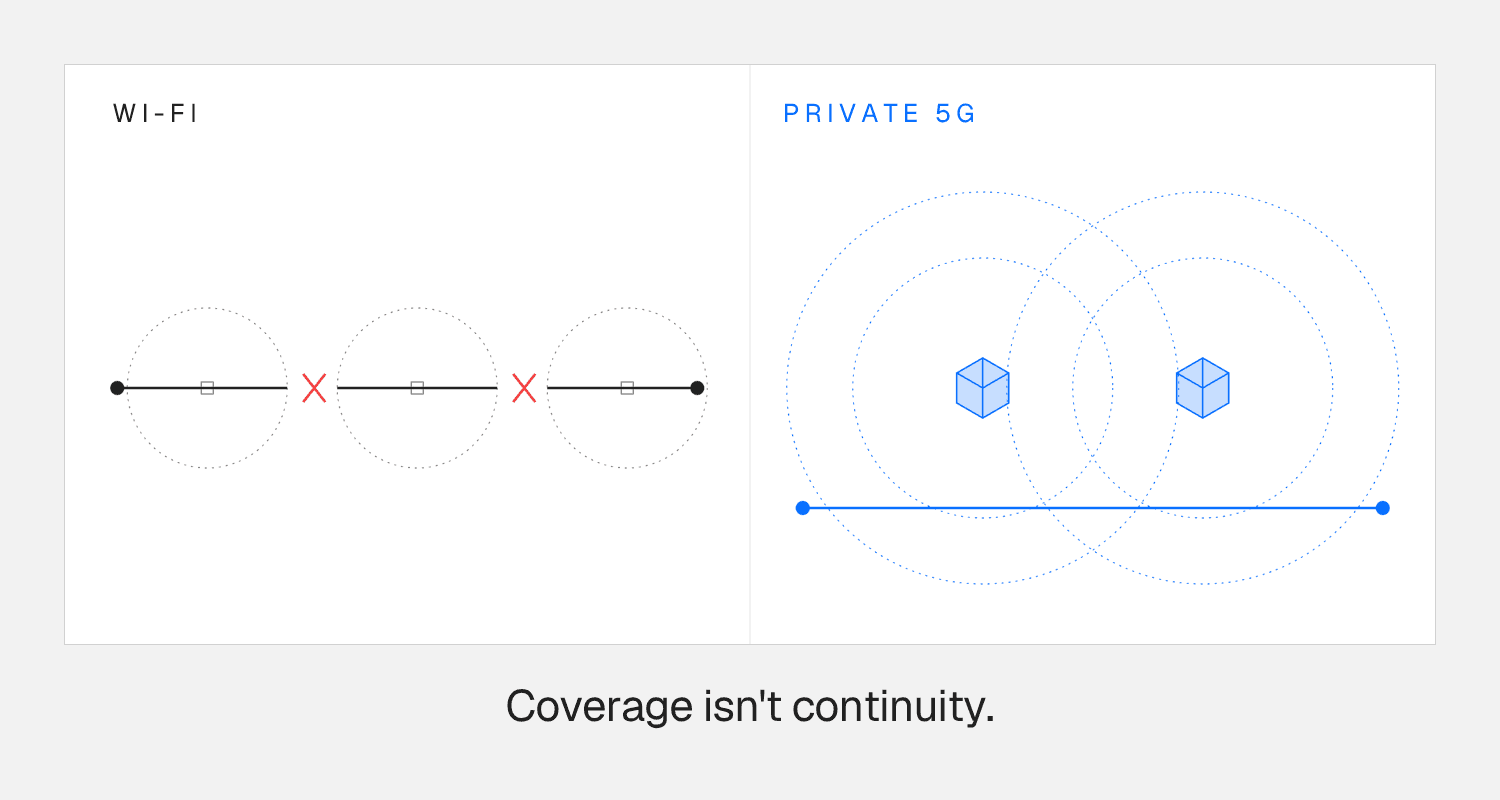
A warehouse doesn't just need coverage.
It needs continuous, reliable connectivity as devices move through the environment.
That distinction matters.
Private 5G: Designed for Mobility at Scale
Private 5G introduces a different approach.
Instead of relying primarily on Wi-Fi access points distributed throughout a facility, private cellular networks can provide broad-area coverage using cellular technology designed for mobility and high device density.
For warehouse operators, that can open up new possibilities.
A single private cellular network can potentially support connectivity across multiple areas of an operation, including:
Warehouse floors
Loading docks
Distribution centers
Outdoor yards
Parking areas
Storage facilities
Remote operational zones
This can be particularly valuable for businesses where the operation doesn't stop at the warehouse door.
The network can extend with the workflow.
And that changes how organizations can think about connectivity.
Instead of asking:
"Where should we put another access point?"
The question becomes:
"How do we create reliable connectivity across the entire operational environment?"
Private 5G vs. Wi-Fi: What Should Warehouse Leaders Consider?
There isn't a universal winner.
The right solution depends on the operation.
Here's how the two technologies compare across some of the areas that matter most to warehouse operators.
Consideration | Wi-Fi | Private 5G |
Indoor connectivity | Strong | Strong |
Device compatibility | Excellent | Growing |
Mobility | Good with proper design | Excellent |
Large-area coverage | Requires multiple access points | Well suited |
Roaming | Can require careful network design | Built for cellular mobility |
Device density | Can become challenging | Designed for high device density |
Operational control | Network-dependent | High |
Outdoor expansion | May require additional infrastructure | Well suited |
IoT connectivity | Good | Excellent |
Industrial mobility | Good | Excellent |
AI and real-time applications | Application-dependent | Strong potential |
Deployment complexity | Generally lower | Generally higher |
Best fit | Traditional enterprise connectivity | Large-scale, mobile, mission-critical operations |
The important takeaway isn't that private 5G replaces Wi-Fi.
It's that different parts of a warehouse may have different connectivity requirements.
What About Forklifts?
Forklifts are a great example of where warehouse connectivity gets complicated.
A forklift isn't sitting in one location.
It's moving.
It's carrying valuable inventory.
It's often operating in areas where coverage needs to be consistent.
And the technology connected to it may be increasingly important to the operation.
Imagine a forklift equipped with:
A rugged computer
An inventory management application
Barcode scanning
Location tracking
Video
Voice communication
Real-time task assignments
Now imagine that connection drops as the forklift moves through the facility.
The result may not be catastrophic every time.
But repeated connectivity issues can create friction.
Tasks can be delayed.
Information can become outdated.
Workers may have to stop and reconnect.
Over time, small connectivity problems can become operational problems.
Private 5G can be particularly interesting for these mobile applications because cellular networks are designed around mobility.
The goal isn't simply to connect the forklift.
It's to keep the forklift connected as it moves.
What About Mobile Robots?
Warehouse automation is changing rapidly.
Autonomous mobile robots and other robotic systems are increasingly being used to move inventory, assist workers, and optimize warehouse workflows.
These systems depend on connectivity to communicate with the applications and infrastructure around them.
A robot may need to:
Receive instructions
Send status updates
Navigate the environment
Communicate with other systems
Share operational data
Access cloud or edge applications
In these environments, connectivity becomes part of the automation architecture.
A network interruption isn't just an inconvenience.
It can affect the workflow itself.
Private 5G can provide a foundation for highly mobile devices and connected machinery operating across large environments.
And when paired with edge computing, organizations can potentially process time-sensitive data closer to where it is generated.
That combination (private connectivity plus edge intelligence) is where the conversation becomes particularly interesting for the future of warehouse automation.
AI Cameras Are Changing the Network Conversation
AI and computer vision are also creating new demands.
Cameras are no longer used simply to record what happened.
Increasingly, organizations are using computer vision to analyze what's happening in real time.
Applications can include:
Safety monitoring
Inventory visibility
Traffic analysis
Asset tracking
Process optimization
Security
Operational analytics
But video creates data.
A lot of data.
And when that data needs to be analyzed in real time, organizations have to think carefully about how information moves through the network.
Sending every video stream to a distant cloud environment may not always be the best approach.
This is where edge computing becomes important.
By processing data closer to where it is generated, organizations can potentially reduce latency, improve responsiveness, and limit the amount of data that needs to travel across the network.
Private 5G can provide the connectivity layer.
Edge computing can provide the intelligence layer.
Together, they create a powerful architecture for applications that depend on real-time data.
The Warehouse Doesn't End at the Loading Dock
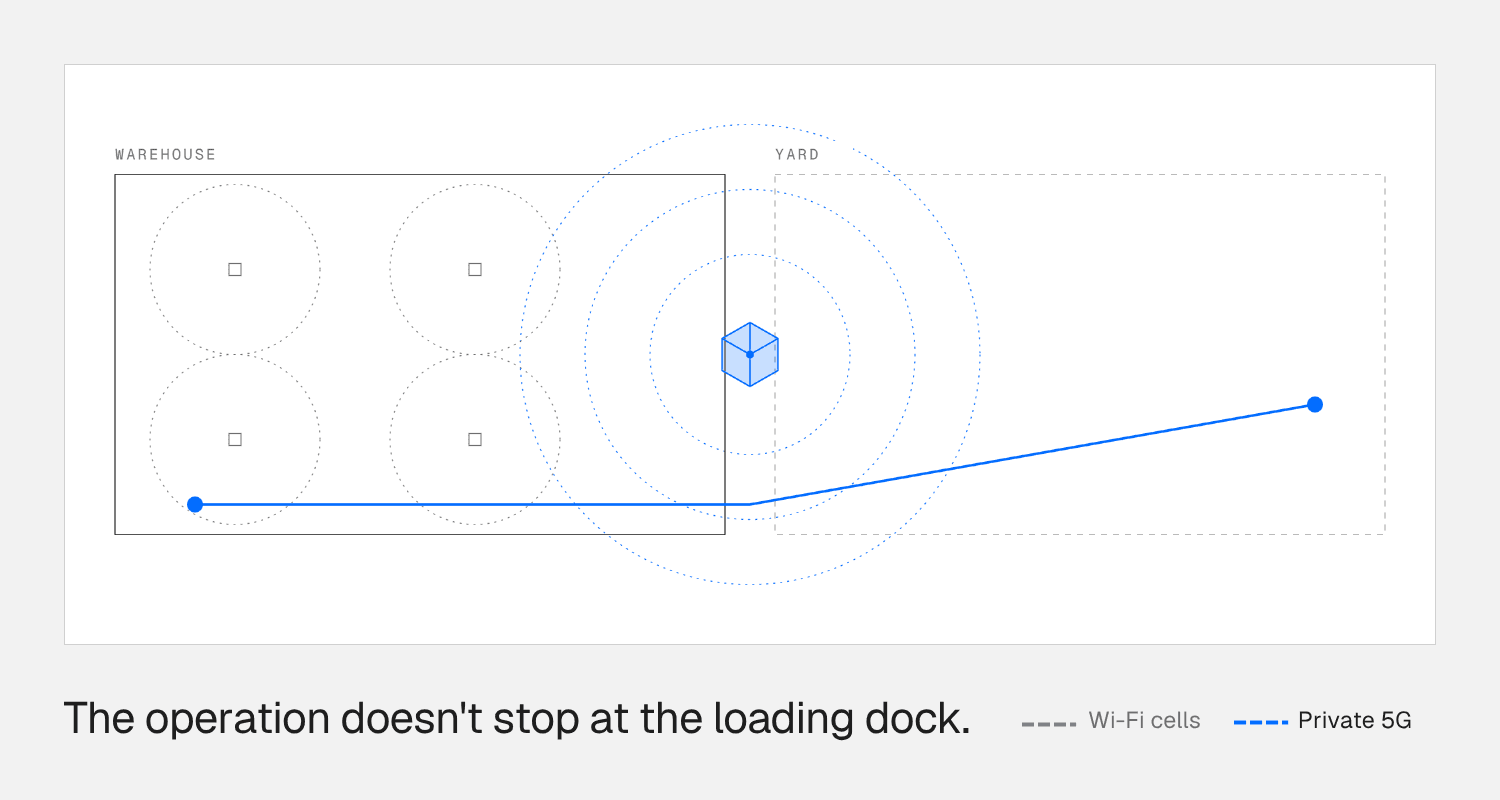
One of the biggest challenges for warehouse connectivity is that the operation often extends beyond the building.
Think about everything happening outside:
Trucks arriving.
Trailers being staged.
Yard vehicles moving.
Employees walking between buildings.
Inventory being transferred.
Security cameras monitoring activity.
Equipment being tracked.
The warehouse and the yard are part of the same operation.
But they may not have the same connectivity requirements.
Wi-Fi can work well in controlled indoor environments.
But extending reliable coverage across a large outdoor yard can require additional infrastructure and careful network planning.
Private 5G can offer an alternative approach for organizations that need broader connectivity across both indoor and outdoor operational areas.
This is particularly relevant for distribution centers, logistics hubs, and large industrial facilities where the boundary between "warehouse" and "yard" is becoming increasingly blurred.
Security and Control Matter, Too
Connectivity isn't only about speed.
For enterprise IT teams, security and control are equally important.
Modern warehouses may be handling sensitive operational data, connected devices, proprietary systems, and automated equipment.
The network supporting those systems needs to be designed with security in mind.
Private 5G can give enterprises greater control over how their cellular network is deployed and managed.
That can be particularly valuable for organizations that want connectivity designed around their specific operational environment rather than relying entirely on shared public infrastructure.
The result is a shift in mindset.
The network becomes something the organization can design around its business requirements.
Not simply something the business has to adapt to.
So, Which Is Better: Wi-Fi or Private 5G?
The answer depends on what you're trying to connect.
For many warehouses, Wi-Fi remains an important part of the connectivity strategy.
It's familiar.
It's flexible.
It's cost-effective for many applications.
And it supports an enormous range of devices.
But private 5G becomes increasingly compelling when the environment requires:
Large-area coverage
High device mobility
Consistent connectivity
High device density
Indoor and outdoor coverage
Industrial IoT
Mobile robotics
Connected vehicles
Real-time applications
Greater network control
And in many cases, the answer isn't Wi-Fi or private 5G.
It's Wi-Fi and private 5G.
The technologies can work together.
Wi-Fi can support traditional enterprise applications and devices.
Private 5G can support highly mobile, industrial, and operational applications.
The goal isn't to replace one network with another.
The goal is to build a connectivity strategy around the way the business actually operates.
KEEN Perspective: Start With the Operation
At KEEN, we believe the right connectivity conversation starts with the environment.
Not the product.
Not the buzzword.
Not the technology of the moment.
The first question should be:
What are you trying to connect?
Then:
Where does it need to operate?
Then:
How does it move?
Then:
What happens if the connection goes down?
And finally:
What does the network need to support five years from now?
Those questions can lead to very different answers depending on the business.
A small warehouse with a handful of fixed devices may have very different requirements from a massive distribution center with autonomous robots, connected forklifts, AI cameras, and an outdoor yard.
That's why there's no one-size-fits-all answer.
The best network is the one that matches the operation.
KEEN Product Spotlight: Connectivity Built for the Real World
Choosing a network strategy is only part of the equation.
The hardware connecting your operation to that network matters, too.
That's where KEEN Validated Devices come into the picture.
Rather than asking customers to navigate a massive catalog of enterprise hardware on their own, the KEEN Shopify Store provides a curated selection of devices designed to support real-world connectivity requirements.
Featured: Cradlepoint R1900
For mobile and vehicle-based applications, the Cradlepoint R1900 is an example of the type of enterprise networking hardware that can support connectivity in demanding operational environments.
Think about the applications that move around a warehouse or logistics operation.
Mobile equipment.
Vehicles.
Field operations.
Connected systems.
These environments require connectivity that can move with the operation.
The R1900 represents one potential solution for organizations looking to connect mobile assets and operational technology beyond a traditional fixed network.
Featured: Inseego FX3100
The Inseego FX3100 represents another approach to enterprise connectivity, offering a solution that can be considered for fixed and flexible deployments where reliable cellular connectivity is important.
For organizations evaluating how to extend connectivity to areas where traditional infrastructure may be difficult or costly to deploy, cellular networking can provide another option to consider.
The key isn't choosing a device because it's the newest or most powerful.
It's choosing the right device for the job.
That's the philosophy behind KEEN Validated Devices.
The hardware should serve the solution - not the other way around.
A Practical Approach to Choosing Your Warehouse Network
Before deciding between Wi-Fi, private 5G, or a combination of both, ask these questions:
1. How large is the operational environment?
Is connectivity needed inside one building?
Across multiple buildings?
Across an outdoor yard?
Across an entire campus?
2. How mobile are your devices?
Are most devices stationary?
Or are forklifts, robots, vehicles, and workers constantly moving?
3. How critical is connectivity?
Can employees simply reconnect if the network drops?
Or does downtime immediately affect operations?
4. How many devices will connect?
Are you connecting dozens of devices?
Hundreds?
Thousands?
5. What applications are you running?
Basic inventory systems have different requirements than real-time video analytics, robotics, or industrial IoT.
6. What happens next?
Your network should support today's operation.
But it should also give you room to grow.
If your roadmap includes more automation, AI, robotics, computer vision, or connected equipment, your connectivity strategy needs to account for that future.
The Future of the Warehouse Is Connected
The modern warehouse is becoming more intelligent.
More automated.
More mobile.
More dependent on data.
As that transformation continues, connectivity becomes increasingly important.
The question isn't whether warehouses will need reliable networks.
They already do.
The question is whether the network is ready for what's coming next.
Wi-Fi will continue to play an important role.
Private 5G will continue to expand into new industrial applications.
Edge computing will bring intelligence closer to the operation.
AI and automation will create new demands for reliable, low-latency connectivity.
And the most successful organizations will be the ones that bring these technologies together strategically.
The right network isn't necessarily the newest network.
It's the network that fits the way your business moves.
Because when your warehouse is constantly moving, your connectivity needs to move with it.
Explore the KEEN Approach
Want to explore connectivity solutions for your warehouse, distribution center, or industrial operation?
Start with the problem you're trying to solve.
Then explore the technology.
Then find the hardware that fits.
The KEEN Shopify Store brings together KEEN Validated Devices designed to help organizations explore enterprise connectivity solutions, from routers and gateways to rugged devices built for demanding environments.
See the KEEN Validated Devices used to support modern industrial and enterprise operations.